


- AI inference and machine learning
- Data science and compute pipelines
- GPU-accelerated enterprise workloads
- Predictable profile-based resource allocation
- CAD, CAE and engineering workflows
- GPU rendering and visualization
- VDI and remote workstations
- Scalable graphics virtualization
NVIDIA vGPU Hosting for AI, Rendering and Cloud Workstations
NVIDIA vGPU server hosting is ideal for artificial intelligence, machine learning, inference workloads, GPU rendering, professional visualization, CAD workstations and virtual desktop environments. Instead of deploying local high-end workstations for each user, businesses can centralize GPU resources in a scalable enterprise platform.
This enables controlled capacity planning, clean tenant separation, profile-based GPU resource allocation and a much more efficient operating model for teams, departments and enterprise environments with structured GPU requirements.
Blackwell RTX PRO vGPU Platform for Professional Enterprise Workloads
menkiSys relies exclusively on NVIDIA Blackwell RTX PRO platforms for vGPU deployments. This creates a clean platform strategy for business customers who need modern GPU virtualization with consistent profile logic, predictable results and enterprise-ready operating standards.
Whether your workload focuses on AI inference, GPU-powered engineering, remote graphics workstations, VDI, visualization or rendering, the combination of Blackwell RTX PRO technology, defined vGPU profiles and Austrian enterprise hosting creates a strong foundation for productive deployment.
Enterprise vGPU Infrastructure from a Family-Owned Austrian Datacenter
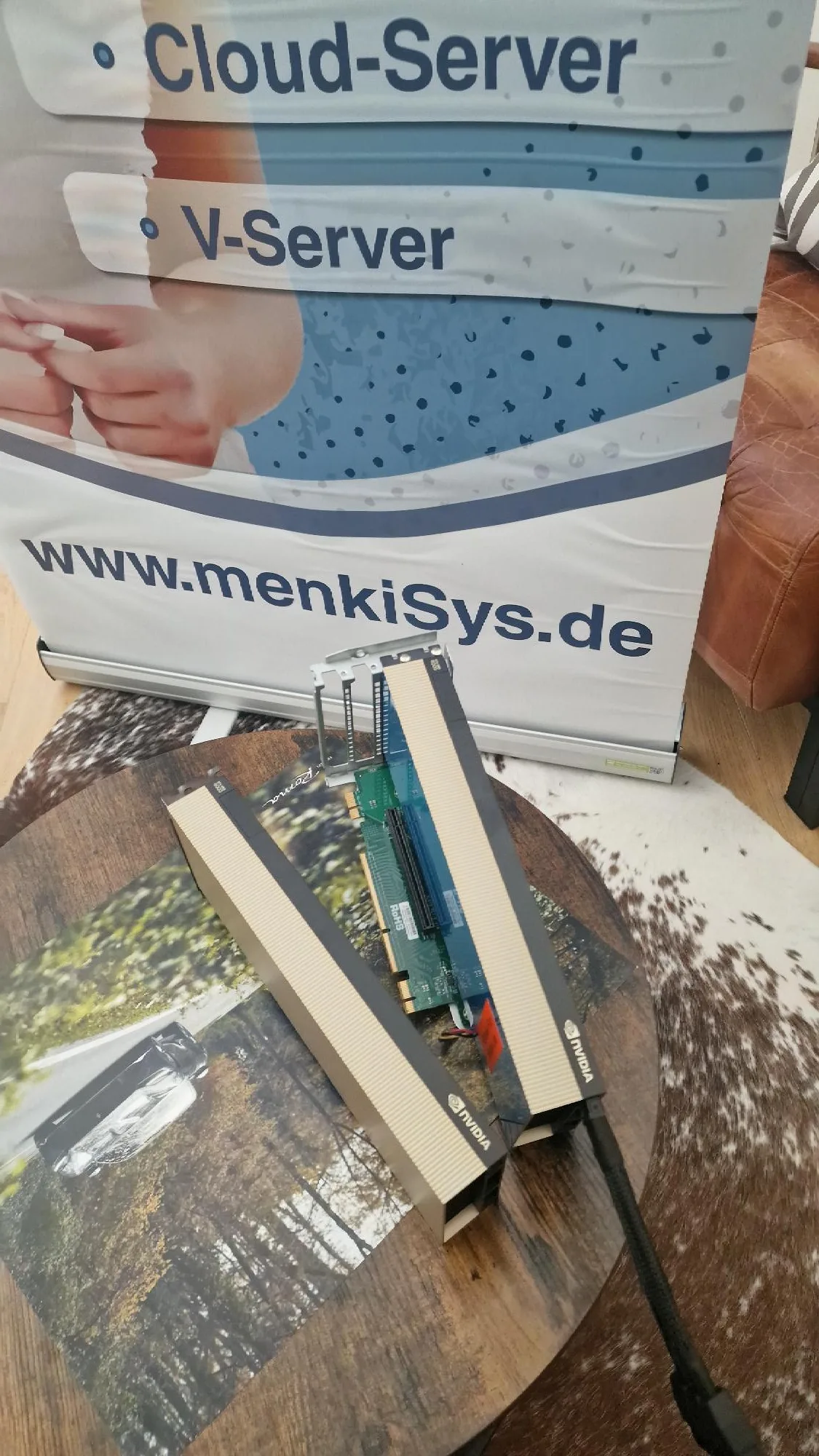
menkiSys operates its GPU and hosting infrastructure as a family-owned technology company in Austria. This creates shorter decision-making paths, direct accountability and significantly more personal technical support than anonymous global hyperscaler structures. For organizations that rely on NVIDIA vGPU hosting, GPU virtualization and productive cloud workstation environments, this operating model provides a clear strategic advantage. Instead of standardized mass hosting with constantly changing contacts, menkiSys offers a controlled, transparent and technically well-managed environment for demanding business workloads and professional virtual GPU deployments. For enterprise customers, agencies, engineering teams and AI-driven organizations, this means a more controlled operating environment for productive vGPU services, cloud workstations and dedicated business GPU virtualization. Especially for NVIDIA vGPU servers, virtual GPU workstations, CAD cloud workstations, GPU-enabled VDI environments, remote workstations and GPU-accelerated business applications, a stable operational framework is critical. menkiSys combines modern NVIDIA vGPU platforms with clearly defined resources, professional hosting in Austria, structured operational processes and direct technical support. This creates the foundation for scalable vGPU infrastructures, clean tenant separation, reproducible performance and a hosting model designed for productive enterprise environments. For organizations looking for NVIDIA vGPU hosting in Austria, GDPR-compliant GPU virtualization, enterprise VDI with GPU acceleration, cloud workstations for CAD and rendering or GPU resources for AI inference and engineering workloads, a family-owned hosting provider with direct responsibility offers real operational value. menkiSys therefore provides not only technical platforms for NVIDIA vGPU services, but also a stable long-term operating foundation for companies that require reliability, structure and professional service quality in virtual GPU hosting, remote workstation environments and enterprise GPU virtualization.
For enterprise customers, agencies, engineering teams and AI-driven organizations, this means a more controlled operating environment for productive vGPU services, cloud workstations and dedicated business GPU virtualization.
NVIDIA vGPU Servers Explained
Key technical and operational questions about NVIDIA vGPU hosting, Blackwell RTX PRO, VMware vSphere, current NVIDIA drivers, multi-GPU setups, vGPU profiles and enterprise deployment
-
An NVIDIA vGPU server is a host system that splits a physical GPU into multiple isolated virtual GPU instances using NVIDIA vGPU technology. Each VM receives defined GPU resources and behaves like a dedicated GPU workstation or compute environment.
-
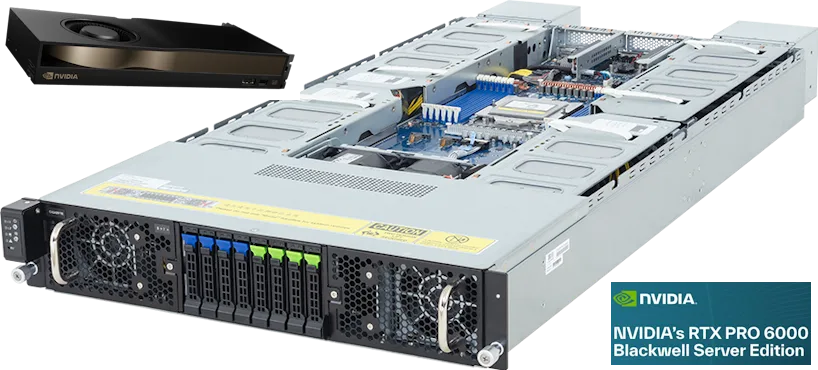
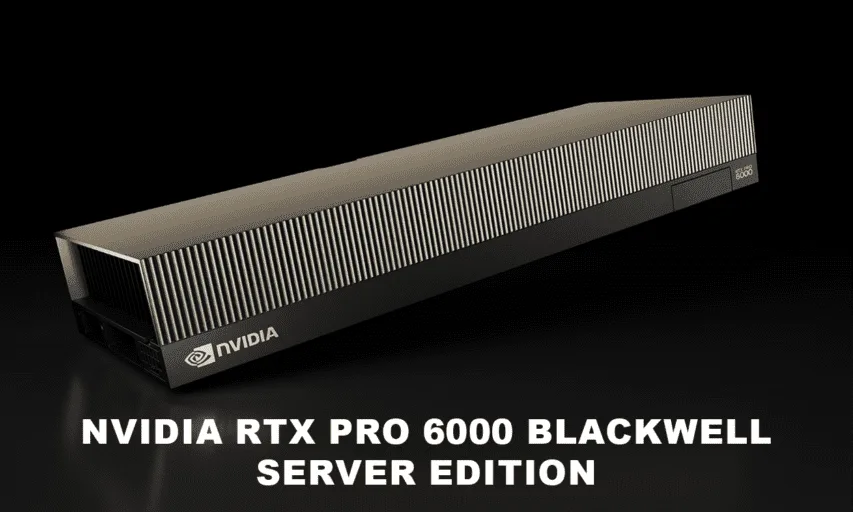
menkiSys uses NVIDIA Blackwell RTX PRO platforms for vGPU environments, including RTX PRO 6000, RTX PRO 5000 and RTX PRO 4000 classes. This creates a consistent enterprise platform with stable profile logic and a clean operational baseline.
-
vCS is optimized for compute-oriented workloads such as AI, machine learning, data science and GPU-accelerated processing. vWS is designed for professional graphics and workstation use cases including CAD, rendering, visualization, VDI and remote workstations.
-
Typical workloads include AI inference, machine learning development, rendering, visualization, CAD/CAE, VDI, cloud workstations, engineering applications and GPU-accelerated productivity environments for multiple users.
-
vGPU enables better utilization, lower cost per user, cleaner scaling and more efficient central management. Instead of operating multiple physical workstations or GPU servers, enterprises can centralize GPU resources in a controlled platform.
-
Yes. vWS profiles are specifically designed for workstation-oriented use cases such as CAD, 3D visualization, remote graphics desktops and engineering environments where stable user experience and predictable graphics performance are important.
-
Yes. menkiSys helps analyze your workload, user density, GPU requirements, profile strategy and infrastructure targets in order to define a technically suitable and economically stable vGPU environment.
-
As of September 2026, NVIDIA vGPU Software 20.2 is the current production branch for modern NVIDIA vGPU environments. It uses the R595 driver family with Linux vGPU Manager 595.91.04, Linux guest driver 595.91.07 and Windows guest driver 596.86. NVIDIA vGPU Software 19.6 remains the current long-term-support branch based on R580 with vGPU Manager 580.178.05, Linux guest driver 580.178.04 and Windows guest driver 582.78. menkiSys selects the driver branch according to the validated combination of GPU, VMware hypervisor and guest operating system instead of installing a new driver without compatibility testing.
-
menkiSys operates its vGPU virtualization platform on VMware vSphere / VMware ESXi 8.0.3. The combination of VMware virtualization, NVIDIA vGPU Manager and the guest driver is coordinated according to NVIDIA's support matrix. This is especially important for NVIDIA RTX PRO 6000 Blackwell Server Edition systems because the hypervisor build, vGPU software branch and guest driver must be compatible for stable productive operation.
-
Yes. menkiSys can design multi-GPU vGPU servers with several physical NVIDIA GPUs and multiple virtual GPU instances. Depending on the GPU model, profile size, licensing and workload, up to 16 vGPU instances can be deployed in a targeted server configuration. On an NVIDIA RTX PRO 6000 Blackwell Server Edition with 96 GB, for example, NVIDIA defines time-sliced Q-series profiles down to DC-6Q, which allows up to 16 equal-size vGPUs on one physical GPU. With multiple physical GPUs in the same server, the overall vGPU density can be scaled further. NVIDIA also supports multiple vGPUs assigned to the same VM on supported configurations, with up to 16 vGPUs per VM.
-
An NVIDIA vGPU profile defines how much GPU framebuffer and which feature set a virtual machine receives. The profile therefore determines the usable GPU memory, the possible number of vGPU-backed VMs and the target workload. Q-series profiles are aimed at professional graphics and NVIDIA RTX Virtual Workstation workloads, while compute-oriented C-series profiles are used for AI and compute scenarios through the corresponding NVIDIA software stack. Selecting the correct vGPU profile is one of the most important sizing decisions for CAD, rendering, VDI, AI inference and GPU cloud workstations.
-
The NVIDIA RTX PRO 6000 Blackwell Server Edition with 96 GB supports a broad range of time-sliced Q-series vGPU profiles. Depending on the selected mode and software release, profiles include DC-96Q, DC-48Q, DC-32Q, DC-24Q, DC-16Q, DC-12Q, DC-8Q, DC-6Q, DC-4Q and DC-3Q. This allows menkiSys to size virtual GPU workstations from compact multi-user environments to large professional VMs with substantial dedicated framebuffer. The optimal profile is selected according to application, number of users, GPU memory demand and expected peak load.
-
For CAD, 3D rendering, visualization and professional remote workstations, Q-series profiles with NVIDIA RTX Virtual Workstation functionality are generally the relevant class. Smaller profiles can be sufficient for office-oriented 3D work and light CAD, while larger profiles such as 12 GB, 24 GB, 48 GB or 96 GB are suitable when large models, high-resolution textures, complex rendering scenes or several GPU-intensive applications must run simultaneously. menkiSys can therefore match the vGPU profile to the real workload instead of oversizing every VM.
-
AI inference, CUDA applications, machine learning development and other compute-heavy workloads require profile sizing based primarily on model size, GPU memory demand and concurrency. NVIDIA provides compute-oriented C-series vGPU types through NVIDIA AI Enterprise, while Q-series profiles are typically used when professional graphics and RTX workstation functionality are also required. menkiSys can design AI vGPU servers with 8 GB, 12 GB, 16 GB, 24 GB, 32 GB, 48 GB or larger GPU memory allocations depending on the supported profile and target platform.
-
In many deployments, yes. One of the major advantages of NVIDIA vGPU hosting is that the GPU allocation can be adapted to changing requirements within the capabilities of the physical GPU, the installed vGPU software and the licensing model. A virtual workstation can therefore move from a smaller vGPU profile to a larger framebuffer profile when projects become more demanding. This gives companies a scalable alternative to replacing complete physical GPU workstations every time more graphics or AI performance is required.
-
With GPU passthrough, a complete physical NVIDIA GPU is assigned directly to one virtual machine. NVIDIA vGPU, by contrast, can divide a supported physical GPU into several virtual GPU profiles so that multiple VMs share the GPU with defined framebuffer allocations. Passthrough is attractive for workloads that require the entire physical GPU, while vGPU is ideal for scalable VMware cloud workstations, VDI, CAD, rendering and multi-user GPU environments where isolation, flexible sizing and higher hardware utilization are important.
-
A productive NVIDIA vGPU environment is a coordinated stack consisting of the physical GPU, VMware ESXi, NVIDIA vGPU Manager, guest VM driver, vGPU profile and NVIDIA license. Incompatible manager and guest driver combinations can prevent the virtual GPU from loading correctly. menkiSys therefore treats vGPU driver updates as infrastructure changes: the VMware version, NVIDIA support matrix, profile type, guest operating system and application requirements are checked before deployment. This approach is essential for stable enterprise vGPU hosting, CAD cloud workstations, AI virtual machines and remote GPU desktops.
99.5% network SLA. 99.9% availability can be agreed in a separate contract. Product-specific service commitments remain applicable.
